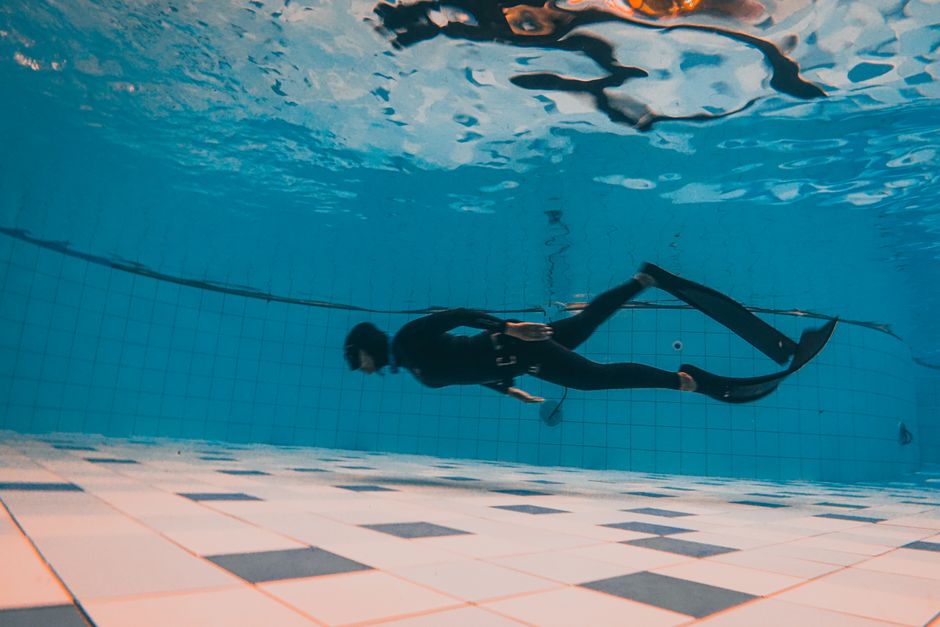
What is static apnea?
Static apnea is simply a timed breath-hold performed while remaining still. Typically it is done face-down at the surface with the face submerged (wet static) or while lying or seated on land with the airway closed (dry static). The goal is not to move or to cover distance but to cultivate breath control, relaxation and awareness of the body’s signals during a suspended respiratory cycle.
There are two common formats:
- Wet static — floating face-down at the surface, usually wearing a low-volume mask and breathing through a snorkel during the breathe-up.
- Dry static — holding the breath while lying on a mat or sitting in a stable chair; useful for early training, mental rehearsal and when water access is limited.
Static apnea matters because it isolates the breath-hold. Without the added demands of finning, equalizing or depth changes, you can learn to relax the body, interpret urge-to-breathe sensations and practice safe recovery patterns. These skills are the foundation for dynamic and depth disciplines — better breath control and calm responses translate directly into more efficient dives.
Basic physiology: CO2, oxygen and the urge to breathe
The most important point to remember is that the drive to breathe comes primarily from rising carbon dioxide (CO2), not from falling oxygen (O2). As you hold your breath CO2 accumulates and acts on the brain’s respiratory center to create the urge to breathe. That urge is a protective signal; it usually appears while there is still significant oxygen reserve.
Common sensations as CO2 rises include:
- Diaphragm contractions — an involuntary tightening or spasming of the breathing muscle.
- Swallowing or throat sensations — a feeling of needing to clear the throat or swallow.
- A warm or pressure-like sensation in the chest as breathing muscles contract.
These sensations are uncomfortable but are not themselves proof that oxygen is dangerously low. They are the body’s warning system telling you to end the hold before you reach a risky state. Learning to recognize and respect them is central to safe static apnea practice.
Two physiological helpers that extend safe breath-holds are relaxation (which lowers metabolic rate) and the mammalian dive reflex. The dive reflex — triggered by facial immersion in cool water and by elevated CO2 — tends to slow the heart rate and redistribute blood toward the torso and brain, conserving oxygen. When you combine calm posture, efficient breathing mechanics and proper safety procedures, these responses support longer, safer holds.
Safe breathe-up and final-breath technique
The breathe-up is preparatory breathing done before the final breath. It should be slow, diaphragmatic and intentionally calming. Your aim is to lower your heart rate, reduce unnecessary muscle tension and arrive at the start of the hold in a state of skeletal relaxation.
A few practical points:
- Use slow, belly-centered breaths. Inhale gently through the nose or mouth while letting the abdomen expand, then exhale smoothly. The goal is calming, not maximal lung packing or forced hyperventilation.
- Avoid rapid or deep hyperventilation. Excessive hyperventilation drives CO2 down and suppresses your primary urge-to-breathe signal, increasing the risk of passing out unexpectedly.
- Finish the breathe-up with a calm, full but natural inhalation as your final breath. There’s no need to “force” extra air — tension and large inspiratory efforts consume energy and may make relaxation harder.
When you remove the snorkel and start the hold, remain as still as possible. Conserve oxygen by consciously relaxing the face, neck, shoulders and the rest of the body. Neutral buoyancy in the water — usually slightly positive so you float comfortably face-down without kicking — prevents postural strain and helps the dive reflex act efficiently.
Progressive relaxation can be useful: focus attention on softening the jaw, then the eyes and forehead, then the neck and shoulders, then the torso and finally the legs. The less muscular tension you carry, the lower your oxygen consumption will be.
In-water vs dry static: safety and buddy procedures
Wet static carries a distinct in-water risk: if a blackout or an unexpected medical event occurs, the performer can inhale water and suffer serious consequences. For that reason, you must never perform wet static alone. A dedicated supervising buddy should be in the water, watching the performer continuously, timing the attempt and ready to assist.
Buddy duties during a wet static attempt typically include:
- Timekeeping — start and stop a reliable timer and track UTB (urge-to-breathe) and total time if you record those.
- Monitoring — watch facial color, respiratory activity, body tone and level in the water; be attentive to any sudden loss of muscle tone or abnormal breathing patterns.
- Support at surfacing — assist the performer to a safe recovery posture, help them place their feet on a firm surface or hold them upright, and guide recovery breaths if needed.
- Intervention authority — the supervising buddy should be prepared to end an attempt at any sign of distress, regardless of the performer’s wishes.
Dry static is lower risk but not risk-free. Practicing dry static alone is acceptable in a safe environment — lying down on a firm, flat surface where you cannot fall — but avoid pushing hard limits without another person present if you feel light-headed, faint or otherwise unwell.
For both formats, establish clear verbal and visual signals before starting, and agree in advance on when the buddy will end the attempt (for example, on loss of tone, lack of response to a verbal cue, or other abnormal signs).
Training progression and structuring sessions
Static training is most effective when it follows steady, conservative progression rather than occasional maximal efforts. Focus on increasing the time you can tolerate after the urge to breathe (UTB) rather than exclusively chasing larger total times. That approach reduces risk and improves your ability to function under the important sensation of UTB.
A sensible session structure:
- Warm-up: several gentle breath-holds and relaxed breathing to prepare the nervous system and muscles.
- Target attempts: one or more measured holds aiming for a conservative, repeatable target (for example small increases to UTB time).
- Recovery: paced, controlled breathing and rest between attempts; do not rush back into another attempt until you feel recovered.
Keep a logbook where you record warm-up holds, best hold, UTB versus total time, resting heart rate, perceived effort and notes on relaxation or tension. Small, measurable gains over weeks and months are more valuable — and safer — than trying to hit an occasional personal best.
If you have access to supervised coaching, it will help create appropriate CO2 and O2 progressions tailored to your physiology and experience. Manifreediver.ir and similar programs can provide structured progressions and spot technique issues that are hard to self-diagnose.
Common mistakes and how to avoid them
Some mistakes commonly lead to unnecessary risk. Watch for these and practice the safer alternatives:
- Hyperventilating before a hold: don’t. It lowers CO2 and delays the warning signals your body relies on, which can result in an unexpected blackout. Use calm, diaphragmatic breathing instead.
- Pushing through violent contractions: loud, intense diaphragm contractions are a clear signal to end the attempt. Ignoring them or overriding your buddy’s instruction is dangerous.
- Training when impaired or fatigued: avoid breath-holding after heavy exercise, when overtired, or under the influence of alcohol or drugs — your body’s responses will be less reliable.
- Poor buddy communication: lack of agreed signals or confusion about responsibilities increases risk. Discuss roles and stop criteria before the first attempt.
If you ever experience unusual or persistent symptoms after a session — fainting, prolonged shortness of breath, confusion, chest pain or neurological changes — seek professional medical evaluation. A doctor experienced in dive medicine is the proper person to consult. For general guidance on dive safety and incident response, organizations such as Divers Alert Network (DAN) provide recognized resources and recommendations.
Equipment and environment recommendations
Good equipment choices and a calm environment make static apnea more comfortable and safer.
- Mask: a low-volume mask helps keep your face relaxed and reduces mask squeeze or the need for face adjustments.
- Snorkel: used during the breathe-up to allow normal breathing while face-down; remove it only when you are ready to start the hold.
- Exposure protection: an appropriate wetsuit keeps you warm and reduces shivering or involuntary movement that consumes oxygen.
- Buoyancy: fine-tune flotation so you float comfortably face-down. A small flotation aid under the legs can correct sinking or excessive hip rotation.
- Timekeeping: a visible timer — waterproof watch or phone placed safely where both buddy and performer can see it — is essential.
- Location: choose a calm pool lane or sheltered open-water site with easy access to an edge or buoy. Avoid currents, waves and crowded areas where supervision or extraction would be difficult.
How static training improves other freediving disciplines
Static apnea develops several qualities that directly improve your performance in dynamic swimming or depth diving:
- CO2 tolerance: regular static practice conditions you to tolerate higher CO2 levels so you can delay panic and make controlled decisions during a dive.
- Relaxation and economy: learning to reduce muscular tension and lower the metabolic rate saves oxygen during active dives and ascents.
- Familiarity with UTB sensations: when you know the progression of sensations that precede the need to breathe, you’re less likely to panic and more likely to execute efficient recovery breathing.
- Mental focus and recovery patterns: static holds teach you consistent post-surfacing routines — how to recover, breathe and reset — which speeds progression across disciplines.
Much of freediving is learning to stay calm under pressure. Static apnea is a safe, practical way to practice that skill in a controlled setting.
Session checklist and logging for consistent improvement
Before you start, use a short checklist. During and after the session, keep honest notes so progress is steady and safe.
Pre-session checklist:
- Buddy check — confirm roles, signals and emergency procedures.
- Environment check — calm water, easy access to edge/buoy, no swimmers in the immediate area.
- Equipment check — mask, snorkel, exposure protection, flotation and a visible timer.
- Set clear, conservative goals — for example: specific UTB target or number of repeatable attempts.
- Warm-up routine agreed and understood by both buddies.
During the session, log:
- Warm-up hold times and perceived ease.
- Best attempt and whether UTB or total time was the main target.
- Rest intervals, recovery breathing quality and subjective fatigue.
Post-session review:
- Note what felt relaxed and what tightened up (jaw, neck, ribcage, legs).
- Record water temperature, emotional state and any incidents or near-misses.
- Adjust next targets conservatively — small steps build reliable skills.
Consistent logging turns anecdote into data and helps you and your buddy make safe, measurable improvements. If in doubt about any symptom or an unusual response after training, consult a medical professional experienced in dive medicine.
Static apnea is a quiet, exacting practice. Approached with respect for physiology, reliable safety procedures and steady progression, it becomes a powerful tool — not only for improving breath-hold times, but for building the calm, efficient habits that make all freediving safer and more enjoyable.